How parents should plan for their kid’s career pivots.
- August 21, 2026
- Posted by: peakalpha2023
- Categories: Children's education, Financial planning, Goal planning, Livemint, Risk management

While children tend to change interests and, in turn, career paths, the financial challenge of planning ahead remains: how do parents engineer an education fund that is flexible enough to accommodate possible changes in plans?
Written by Ann Jacob for Mint with inputs from Priya Sunder, Director and Co-founder of PeakAlpha.
When Rajeevan KN’s son was in primary school, his dream was to explore deep space as an astronaut. By high school, his focus shifted toward biology and medicine. Shortly after, public policy captured his interest, and today he sits in a second-year law classroom while keeping a close watch on how artificial intelligence is reshaping various industries.
Rajeevan, a 49-year-old senior vice-president at Kotak Life Insurance in Kochi, compares career planning with ice skating, as it demands speed, balance, and rapid directional adjustments.
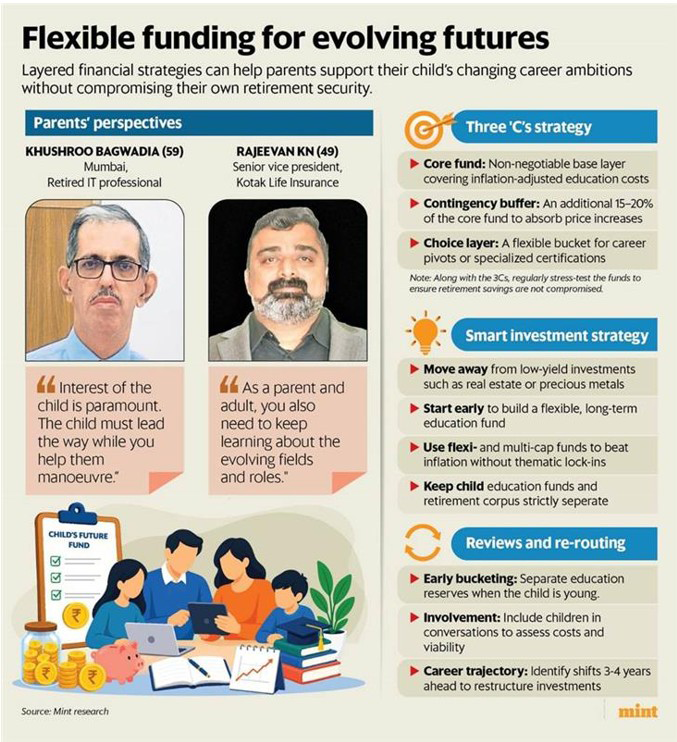
Khushroo Bagwadia, a 59-year-old retired IT professional from Mumbai, said: “The interest of the child is paramount. Parents may want to decide the best option based on the highest salary, but your child must lead the way while you help them manoeuvre.”
To navigate any shifts, as a parent and adult, you also need to keep learning about the upcoming fields and roles, Rajeevan noted.
Sanjay Rahate, an internationally certified master career coach based in Mumbai, noted that today’s landscape spans 20 career clusters, 160 career paths, and over 3,000 new-age distinct occupations.
While traditional roles focused almost exclusively on left-brain tracks like engineering and medicine, Gen Z and Gen Alpha are moving toward creative fields like animation, UI/UX design, and digital media, Rahate said.
He advises parents to test these interests against real-world, short-term projects and objective SWOT (strengths, weaknesses, opportunities, and threats) analyses to validate long-term viability before allocating major education funds.
Rajeevan added that children often discuss career trends with peers and bring ideas home. Given this, openness around family finances has growing importance. If parents share finances transparently, children would then be able to make grounded, informed decisions.
If a child opts for an unconventional or high-cost career shift, early communication gives parents time to make the necessary financial adjustments.
Three ‘C’s strategy
While traditional planning inflates a single course cost into the future, financial advisors call for building layered investment portfolios to handle deviations due to changes in interest or plans.
Priya Sunder, co-founder and director at PeakAlpha Investments, said, while you cannot predict a child’s exact career choice 15 years in advance, you can structure a portfolio based on present value, adjusted for education-specific inflation.
But to manage pivots such as a child abandoning a course midway or switching streams, Priya recommends building a framework around the 3 Cs.
First is the ‘core fund’, which is the non-negotiable base layer calculated using current degree costs, inflated to the year the child enters college based on what the parents can afford.
The second is the ‘contingency buffer,’ which is an additional 15-20% of the core fund. This layer is built on top of the core fund to absorb price surges or course extensions.
And finally, a ‘choice layer’ that is a flexible, secondary wealth bucket designed specifically to fund career pivots, gap years, specialized certifications, or exploratory shifts.
“Literally, you’re running a bit blind into the future. All you can do is create a certain fund for your kid and don’t label it as anything; just say that this is something for my child to be used for whatever goal emerges,” Priya explains.
She stresses that parents must stress-test these layers annually to ensure that funding a late career pivot does not compromise their primary retirement security. If the choice layer falls short, she noted that the child needs to bridge the gap through merit scholarships or education loans.
Santosh Joseph, founder of Germinate Investment Services, reinforces that long-term flexibility requires moving away from rigid, low-yield endowment policies, physical real estate, or precious metals.
“When you do not know what job, career, college, or stream it will be, the only certainty is that you need money,” Joseph noted. To build an adaptable corpus with a 15-to-18-year horizon, Joseph recommends systematic equity investing through flexi-cap or multi-cap mutual funds. These funds spread across market caps, generate inflation-beating compounding without locking capital into narrow thematic sectors.
Goal reviews and re-routing
Financial adaptability also requires involving the child in conversations as they realign interests and real-world costs. Dilshad Billimoria, founder, MD, and chief financial planner at Dilzer Consultants Pvt. Ltd, structures education planning around active goal reviews as children enter their teenage years.
“When the child is very young, we do bucketing of funds. As the child turns 16-17, we include them in the goal review conversations with the parents,” Dilshad explained. During these sessions, the family breaks down the current costs of the child’s target fields, adjusts them for inflation, and assesses the overall viability of the goal.
If a child decides on an unconventional or high-cost career shift, she noted that early communication provides the necessary time to make financial adjustments. “Any change in plan can be discussed at least 3-4 years in advance so we can restructure or replan the investment portfolio accordingly,” said Dilshad.
By combining disciplined early investing, transparent family communication, and a layered approach, the parents’ finances can house their child’s evolving interests without breaking into their own retirement funds.
Priya Sunder is director and co-founder at PeakAlpha Investments.