Montessori, Waldorf, or Reggio Emilia? Why specialized preschools cost up to ₹4 lakh a year
- September 26, 2026
- Posted by: peakalpha2023
- Category: Uncategorized
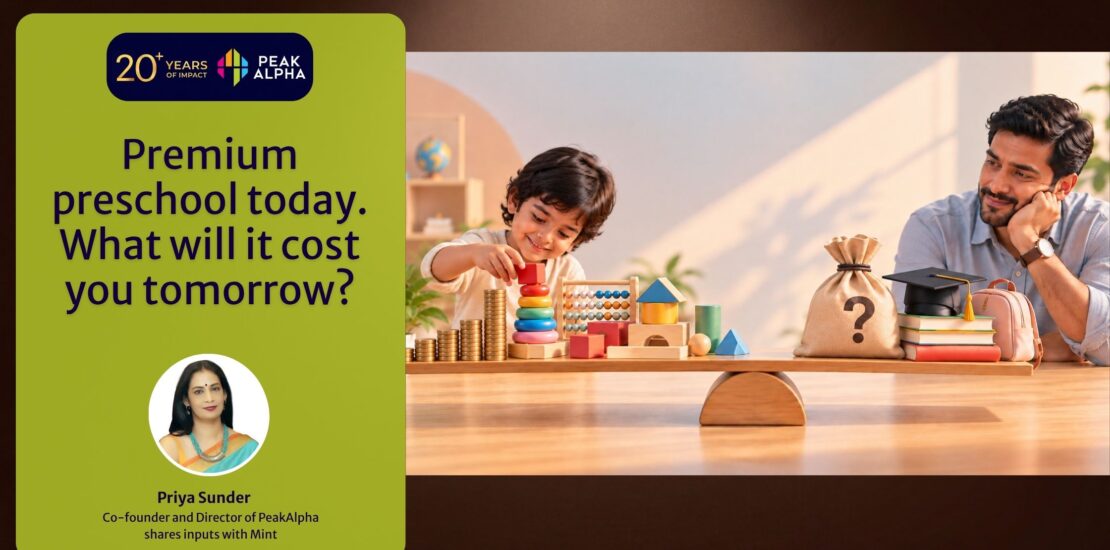
Schools cite specialized teachers, child-friendly equipment, sensory spaces, hygiene and learning environments as drivers of higher fees.
India’s premium preschools are selling specialized learning methods at a steep markup. What are parents actually paying for—and can the spending be sustained through a child’s education?
Written by Ann Jacob for Mint with inputs from Priya Sunder, Director and Co-founder of PeakAlpha.
Nursery rhymes and alphabet tracing are giving way to Montessori, Waldorf, and Reggio Emilia—and preschool fees of up to ₹4 lakh a year. The premium reflects investments in method-specific equipment, learning environments, teachers and other resources, schools say.
In India’s metros, annual fees for pedagogy-based preschools range from ₹2.5 lakh to ₹4 lakh, according to Sana Bhambhani, Centre Head at Safari Kid, Mumbai. By comparison, regular preschools charge ₹60,000 to ₹1.2 lakh a year, based on a Mint review of preschool fees in metros.
For some parents, higher fees can be a proxy for quality, as they seek to give their children an early advantage. But the financial question is whether the premium delivers something they value—and whether the spending can be sustained alongside longer-term education goals.
What parents pay for
For Aditya Gaitonde, a 40-year-old product lead at a fintech firm in Mumbai, enrolling his daughter in a preschool featuring elements of Reggio Emilia, Montessori and Waldorf was less about the labels than about practical developmental milestones. Montessori focuses on child-led independence and practical self-reliance, Waldorf emphasizes nature-centric and imaginative play, while Reggio Emilia centres on hands-on, sensory-first learning.
“Our objective of putting her in playschool was to help her improve her fine motor skills, pick up language, and give her a space where she can interact with other kids and play,” Gaitonde explained.
He paid an annual fee of around ₹1.5 lakh, a sum he felt made financial sense given the school’s infrastructure and student-teacher ratio. The base fee covered stationery kits, a school trip and a sports day.
Gaitonde flagged the trend of mandatory add-ons creeping into preschool costs. Long school hours, such as 8 am to 3 pm, frequently necessitate paid school meal subscriptions, while bus services, specialized arts or sports programmes and extra coaching can push the cost above the initial budget.
“In Indian culture, education is accorded highest priority, and very often fees are a proxy for quality. Parental behavior is probably driven by wanting to do right for your kid at every milestone, and especially not compromising on education,” Gaitonde noted.
Other parents approach early education with more specific pedagogical goals, matching spending to the hours their children spend at school. Simone Burchell Varghese, a 41-year-old clinical ops programme coordinator in Mumbai, researched her options before selecting a purist Montessori setup for her daughter.
“We ended up doing a school where fees are based on the number of hours that the child spends there,” she said. For a 9 am to 1 pm schedule, the annual tuition stood at around ₹1.75 lakh, while extending the day to a 9 am to 3 pm slot pushed the fee to ₹2.85 lakh, alongside add-ons for vegetarian home-cooked meals and snacks.
Varghese said she valued the tangible self-reliance her daughter developed, such as dressing independently or improving fine and gross motor skills.
“There are a lot of places that try to do a mashup of multiple ways, but it’s not necessarily always true to what the original intent was. Another issue is that there are schools that make method learning a kind of luxury product or brand that they sell to the parent,” she noted.
Why methods cost more
For schools, the premium reflects the cost of creating and maintaining specialized learning environments, including investments in teachers, equipment, space and supporting staff.
At Safari Kid, whose model combines Montessori, Waldorf, Reggio Emilia and Play-way methods, Bhambhani said teachers are the biggest investment.
“For these methods, the major point of investment is teachers. It is also standardised, non-toxic and child-friendly equipment, ambience, resources, space, hygiene, and the supporting staff,” Bhambhani explained.
The curriculum from the US is standardized across centres and requires specialized physical equipment. “We have a separate sensory room and outdoor areas. Different equipment takes investment, as a single sensory table would cost about ₹8,000 -10,000. A Tuff Tray is used for sensory and messy play, creative exploration, and hands-on learning activities,” she said.
The only upfront add-ons are separate fees for the annual day, which come to ₹5,000-6,000 and are communicated to parents in advance. Speaking about the long-term impact of method-based learning, Bhambhani added that multi-method exposure can help children adapt to any school board later on.
Developmental check
Dr. Priyanka Parikh, a Mumbai-based developmental pediatrician, emphasizes that the first five years of life are a critical window for rapid brain development, establishing neural networks for physical, motor, language, emotional and social skills. But she noted that high expenditure is not a prerequisite for successful development.
“Developmental experiences need not necessarily be excessive or expensive. Meaningful engagement by a responsive adult in a developmentally and sensory-rich environment would go a long way towards building the foundations for later learning outcomes,” Parikh added.
Dr. Bindu KK, a consultant psychologist based in Trivandrum and a member of the Child Welfare Committee, echoes this. “Play or experience-based learning can support development, but long-term outcomes depend on teaching quality, environment, consistency, and later educational experiences. A thoughtfully designed environment fosters life skills like self-regulation, communication, and problem-solving,” she explained.
The sustainability test
While specialized pedagogies can offer young children developmental experiences and foster independence, the spending needs to be considered alongside a family’s finances and longer-term education goals.
“Parents will run their own calculations on whether it fits their budget, but there is a tale of caution here that you should not fall prey to peer pressure purely because your friends or social circle enrol their child in such a school. You have to see whether it has the same kind of financial viability for your household,” explained Amol Joshi, founder of PlanRupee Investment Services.
“The preschool fees of up to ₹4 lakh on an income of a crore does not make a dent. But if you are struggling every year to come up with fees or dipping into fixed deposits, that is not sustainable,” Priya Sunder, co-founder and director at PeakAlpha Investments, warned.
“Creating a corpus for education typically works for graduation or post-graduation as parents have some years to accumulate this sum. However, parents of a preschool child will hardly have time to accumulate such a large corpus. Hence, these fee-related expenses have to come directly from their regular earnings,” Joshi noted.
Sunder added that enrolling a child in an expensive preschool sets a high benchmark that parents must maintain across primary, secondary and higher education, underscoring the need to consider whether the spending can be sustained.
She also emphasized that every lakh saved during a child’s toddler years can compound significantly over two decades. “Every lakh or two lakhs that parents can put away at a time when you still have 15-18 years to compound can make a meaningful difference in the quality of higher education you can afford later,” Sunder notes.
Joshi also reminds parents that higher education remains the ultimate determinant of a child’s job qualifications and career trajectory.
“If someone has decided to take this route, an upfront annual payment definitely needs planning. The risk of not planning for it is that you will end up taking money out from resources you had allocated for other goals,” Sunder concludes.
Progressive pedagogies may offer children different developmental experiences, but high spending does not by itself guarantee better learning outcomes. The key question for parents is whether the premium delivers something they value without compromising longer-term education goals.
Priya Sunder is director and co-founder at PeakAlpha Investments.